

Home News & updates Article Smarter ATC selection
A global shortage of air traffic controllers has left the industry at a critical juncture. In this feature article published in a special Training issue of Airports International magazine, Airways International explains how best to plug the gap.
Across the globe, air navigation service providers (ANSPs) are grappling with severe controller shortages as air travel rebounds to pre-pandemic levels and beyond. An ageing workforce approaches retirement, new airports continue to be constructed, and passenger numbers surge – yet the pipeline of qualified controllers struggles to keep pace.
Compounding this situation is a sobering reality: in many regions, air traffic control (ATC) training failure rates routinely reach 50%. With ATC training representing a substantial financial investment for ANSPs, these failures translate into massive waste, with a significant portion of global training budgets lost on trainees who never qualify.
Only 3-5% of the global population possesses the unique combination of skill and aptitude required to succeed as an air traffic controller. ANSPs need to test enormous numbers of candidates to identify these rare individuals, yet traditional supervised selection processes create barriers that prevent many potentially excellent candidates from even entering the funnel.
Airways New Zealand’s experience over the past 15 years demonstrates that a fundamentally different approach – one grounded in organisational psychology and innovative use of technology – can transform these outcomes, achieving a 95% training success rate. Their methodology offers a blueprint for ANSPs worldwide.
The SureSelect ATC solution emerged about 15 years ago, when it was recognised that conventional HR selection processes for Airways New Zealand were delivering inconsistent results. The stakes of getting ATC selection wrong are immense – candidates often uproot their families and invest precious time, only to discover six months into training that they won’t succeed.
The SureSelect solution was designed after considerable research and development by organisational psychologists, HR professionals, ATCs and training instructors. “They looked at the actual job of an aerodrome controller and really identified the competencies that underline the job,” explains Philipp Zeitel, Training Quality Manager at Airways International, the commercial arm of Airways New Zealand which delivers SureSelect and ATC training services to Airways and other ANSPs globally.
The competency-based foundation measures everything from spatial awareness and short-term memory to the ability to respond under pressure, teamwork capabilities, and communication skills.
Jonny Cooke, Head of Products at Airways International, emphasises that this approach represents a significant departure from generic aptitude testing, saying: “The key idea is really to focus as much as we can on ATC competencies, and to reduce unnecessary tests or barriers throughout the entire process.”
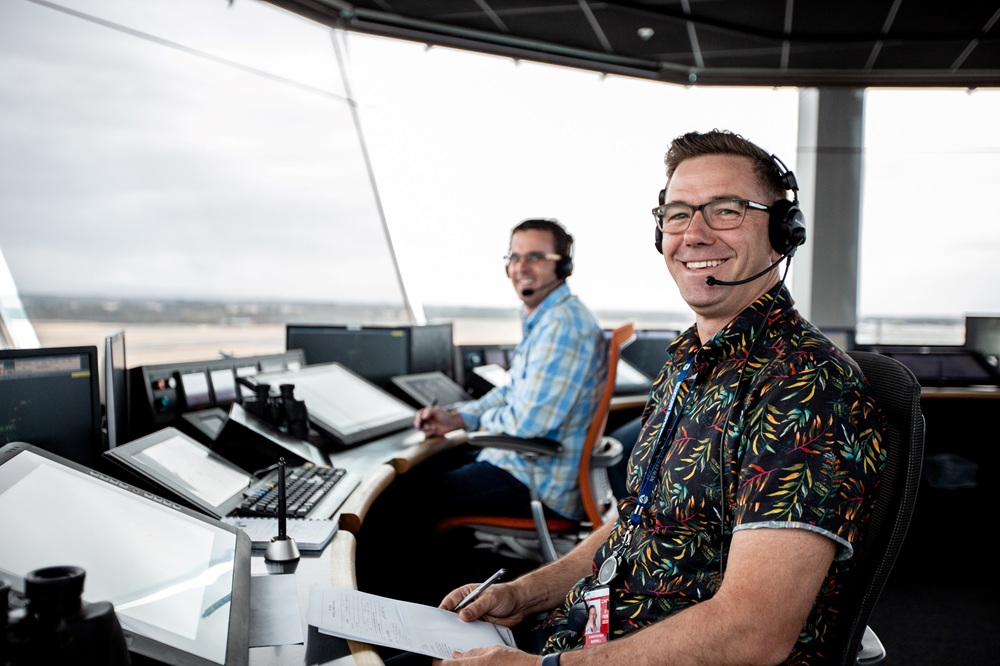
One of SureSelect’s most innovative features is its use of unsupervised online testing for the first three stages of selection. This shift was driven by a fundamental product requirement: the need for a significant number of candidates at the top of the recruitment funnel.
“To identify that top 3% of talent, the intake numbers need to be enormous – a volume that breaks traditional supervised assessments,” Cooke explains. “We redeveloped the platform to solve this volume problem. By moving SureSelect to the cloud, we replaced physical bottlenecks with digital scalability. We can now screen thousands of candidates globally, in the time it used to take to assess a dozen in a classroom.”
This digital-first approach eliminates the friction of legacy methods. When ANSPs previously invited candidates to physical assessment centres without digital pre-screening, dropout rates frequently reached 60%, creating excessive operational waste.
Scaling up the early testing stages
Candidates now complete assessments at home, on their own schedule, removing geographical and logistical barriers. “We don’t need cover letters. We don’t even need CVs. Our educational requirements are the absolute minimum in the beginning,” Zeitel notes.
Airways employs a stage-gate methodology with the testing of candidates. The first round consists of a cognitive ability test which takes about 45 minutes, with about 20% of candidates eliminated. Only successful candidates receive invitations to the second round – ATC skill simulations. Then the final round is a behavioural traits questionnaire. By the time candidates reach the assessment centre, they’ve completed three stages of pre-screening and face about a 50-50 chance of acceptance into the training academy.
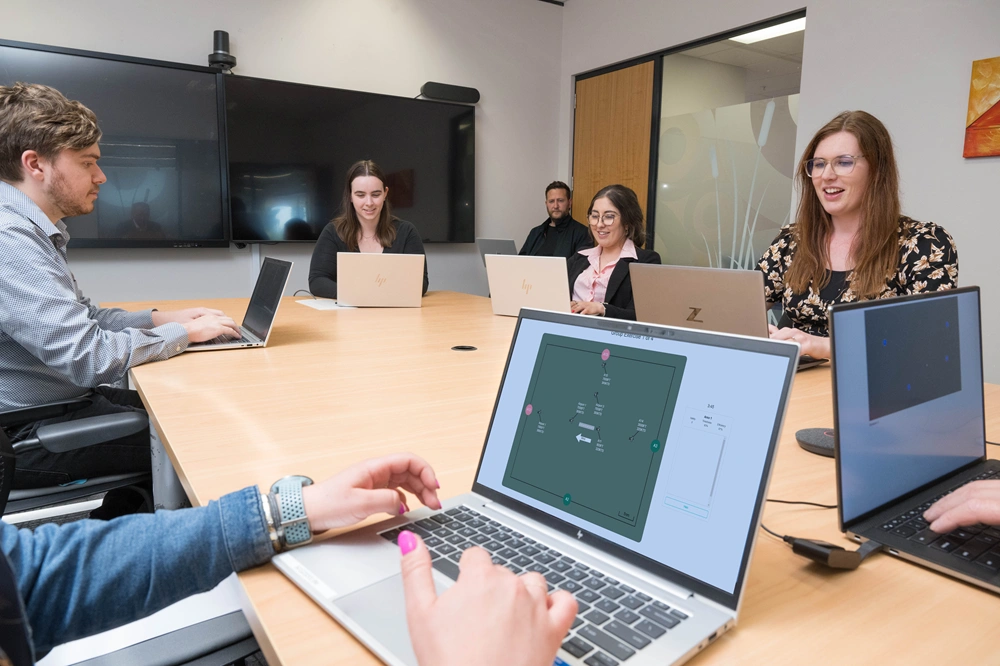
Security concerns naturally arise with unsupervised testing, however experience training candidates for Airways for over 30 years has been reassuring. “Looking back at the last four or five years, we maybe had a handful of times where we were a little concerned,” Zeitel says. “However, we then asked the people to redo their tests at the assessment centre, and they tested exactly the same.”
The system’s effectiveness is best measured by attendance rates. While some ANSPs experience 60% no-shows at assessment centres, the Airways training academy achieves 98-99% attendance. “Every person who’s invited shows up,” Zeitel confirms. “They know it’s a big deal by that stage.”

The effectiveness of the SureSelect approach extends well beyond Airways New Zealand. ANSPs across the globe have used SureSelect assessments, including those in Australia, Azerbaijan, Ghana, Saudi Arabia, Kuwait and Vietnam.
Airservices Australia’s implementation illustrates how ANSPs can strategically adopt the methodology whilst managing risk. The organisation conducted a carefully structured trial in 2021, integrating SureSelect tests alongside established assessments to validate the tool’s effectiveness within their operations.
Following the trial’s success, Airservices has now transitioned to using the full SureSelect suite as their sole selection methodology, demonstrating confidence in its predictive power. This includes implementing the entire process, from unsupervised remote testing through to supervised assessment centre components.
Adopting the SureSelect system
Marcus Knauer, Airservices’ Head of Workforce Resilience, says Airservices’ recent adoption of the full SureSelect methodology has enabled it to assess and observe an alignment between the psychometric testing results and the activity-based group assessment outcomes in their selection process.
“We are now seeing a strong correlation between the psychometric test results and the demonstrated competence of candidates in the aviation related group exercises where these skills are tested,” Knauer says.
“This has had a positive impact on our selection process.”
Cooke explains the typical adoption pathway for ANSPs: “It’s very rare that ANSPs will take everything we do in the exact way that we do it in New Zealand. They will often select a few of the tests and embed it within their existing processes, and then over time they will trial a bit more.”
The system’s cloud-based architecture supports this flexibility. ANSPs can select which components to implement, whether to administer tests in supervised or unsupervised environments, and how to integrate SureSelect into their existing processes.
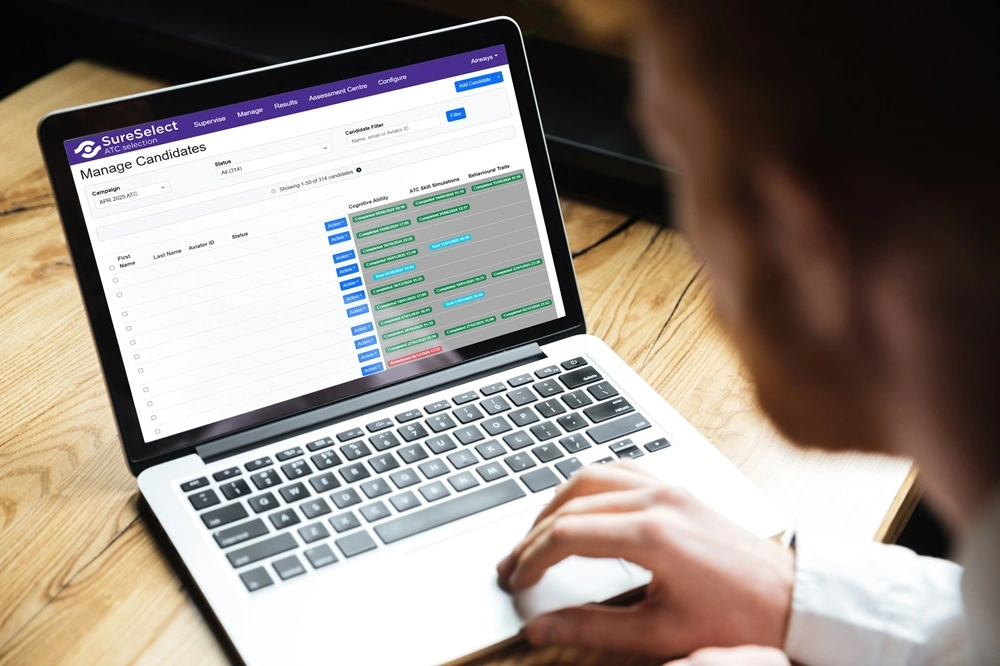
A frequently asked question is whether candidates can improve their performance through practice. “Our tests are designed to really measure a person’s core innate cognitive abilities and behavioural tendencies,” Zeitel explains. Airways allows unlimited re-application by candidates, but data shows minimal improvement from repeated attempts.
Interestingly, the candidate selection for Airways has shown no correlation between formal education and success. “Some of Airways’ best air traffic controllers have come from really varied backgrounds – you certainly don’t need a university degree to succeed in this profession,” Cooke says.
While cognitive abilities form the foundation of selection, behavioural traits prove equally critical. This assessment used by Airways evaluates seven key personality characteristics: the ability to give instructions and take control, adherence to rules, focus on accuracy, organisational skills, emotional regulation, fast decision-making, and openness to feedback.
“It’s quite a specific personality or behavioural profile we’re looking for,” Zeitel says. These soft skills predict not just training success but long-term retention. “People scoring in the realm of what we’re looking for end up staying in the profession for a long time.”

As the aviation industry faces unprecedented controller shortages, the pressure to improve selection and training efficiency has never been greater. Airways’ experience demonstrates that the solution lies not in lowering standards, but in applying rigorous research-based methodology to identify those rare individuals with the right combination of abilities from the outset.
As Zeitel reflects: “If we get it wrong, the potential negative outcomes for candidates and for the organisation are immense. On so many levels, it’s really important to get ATC selection right.”
Airways has proven that getting it right is not just possible – it’s achievable, measurable, and sustainable.