




Running an ATC simulation exercise takes a lot of manual effort. It requires simulator pilots to respond to every controller instruction and training teams to build the traffic for each exercise. These two tasks are among the leading “hidden costs” of owning a sim, and represent millions of dollars between providers when you look at total cost of ownership over the life of your platform.
In TotalControl, we’re using AI to take on some of that work: helping simulator pilots respond to controller instructions, expanding our autonomous pilot capabilities and putting rapid scenario generation in the hands of our instructors.
Our starting point is that human expertise remains central to ATC training. We’re applying AI where it adds practical value, so instructors and simulator teams spend less time on repetitive tasks and more time supporting trainee development.
This article explores two areas of AI development within TotalControl: AI powered autonomous pilots, building on our AutoPilot voice recognition application; and an AI powered flight generator that makes building complex and realistic scenarios faster.
Extending voice recognition into reliable, autonomous pilots
Voice recognition is already an established part of TotalControl through the AutoPilot application. AutoPilot listens to a controller instruction, converts speech to text, interprets and validates the instruction, applies supported aircraft commands and provides a spoken pilot response.
AI unlocks a new level of depth and understanding to the AutoPilot application. This allows us to deploy AI pilot capabilities that support a wider set of commands, both expected and unexpected and opportunities to embed AI into our applications to support our simulator pilots in commanding more aircraft per training scenario.
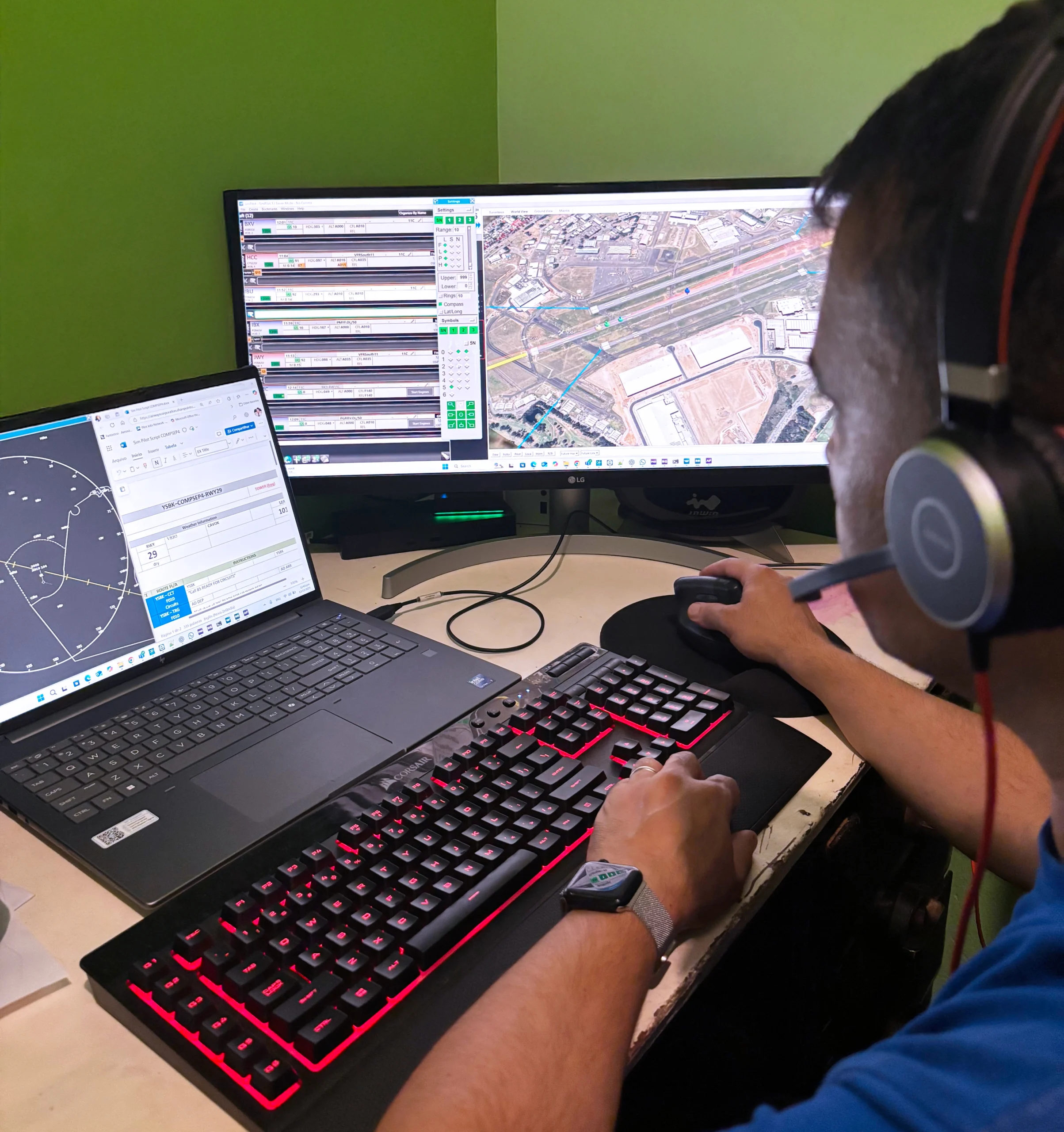
TotalControl supports different levels of AutoPilot assistance for individual aircraft. Under automated operation, understood instructions can be carried out automatically. In assisted mode, the system presents the simulator pilot with what it heard, together with proposed actions and a response. The simulator pilot can review the suggestion, change parameters, remove individual actions, execute the instruction or dismiss it.
This gives simulator teams greater flexibility to determine where AI assistance is appropriate for a particular exercise. Routine instructions can be supported by AI, while the simulator pilot remains directly involved where greater oversight is required.
The level of automation should reflect the objective of each exercise, with instructors and simulator teams retaining control of key decisions.
In addition, AI unlocks far more use cases for self-study opportunities and part task trainers.
Building complex scenarios faster
Another area of AI development for TotalControl is at the other end of the simulation process: creating the exercise itself.
Building a realistic simulator exercise can involve creating and configuring a significant amount of traffic. Scenario development experiences between simulator suppliers can vary, from hours to days for a single exercise. We think that scenario creation should take minutes, achieved in TotalControl with our AI enabled flight generator.
By combining real world flight data with plain language prompts, an instructor can plan a scenario and generate the first draft in a matter of minutes.
TotalControl’s AI flight generator can transform flight data into realistic simulator scenarios in seconds.
Instructors can adjust a scenario by simply telling the system what they want – add international arrivals, reduce the number of flights or change the traffic mix. Traffic can also be generated using historical flight plans, FlightRadar24 data or imported datasets where the appropriate data is available.
Once the instructor is happy with their plan, TotalControl learns from previously validated scenarios to understand “what good looks like”, and in seconds the instructor sees realistic traffic being generated, including flight plans and taxi paths right to their expected gate.
The flights remain editable in our powerful 3D first ExerciseBuilder application, so instructors can review routes, timings and aircraft and make any changes required before using the exercise. The instructor remains responsible for defining and validating the learning objective and intended training challenge.
As users of our own simulators, these are the areas where AI has immediate value for our training system – accelerating the first draft while keeping subject matter experts in control.
More time for training
AI enabled virtual piloting and the AI flight generator address different bottlenecks in the simulator training system, and they share a common goal: making it easier and faster for training teams to create and deliver realistic ATC simulation.
As these capabilities develop, we see opportunities to reduce repetitive work, make simulator resources more flexible and expand the ways trainees can practise.
This technology gives instructors and simulator teams more time to focus on developing capable, confident controllers, while maintaining the realism, control and trust that effective training depends on.
About the author
Jonny Cooke
Head of Products
At Airways International, Jonny Cooke leads a cross-functional team of software developers, product managers, and product specialists to design, develop and deliver innovative solutions for aviation – including the TotalControl simulation solution, AirShare uncrewed traffic management system, and SureSelect ATC selection solution.
Jonny has over 10 years’ experience working in digital products development in an operational, technical and strategic capacity, and has experience and expertise in the deployment of a number of software-based products and services to customers around the world, including numerous ATC simulation deployments. Jonny holds a Master of Information Technology.