




Ask any air traffic controller who’s trained through Airways using our TotalControl simulator to name their first posting, and chances are the answer will be the same: Forest. It’s a name that comes up often in our training centre, usually when an experienced controller steps back into the simulator and says, “I remember when I was here for the first time.” For a place that doesn’t technically exist, it has left a surprisingly lasting impression.
A fictional place, with a real purpose
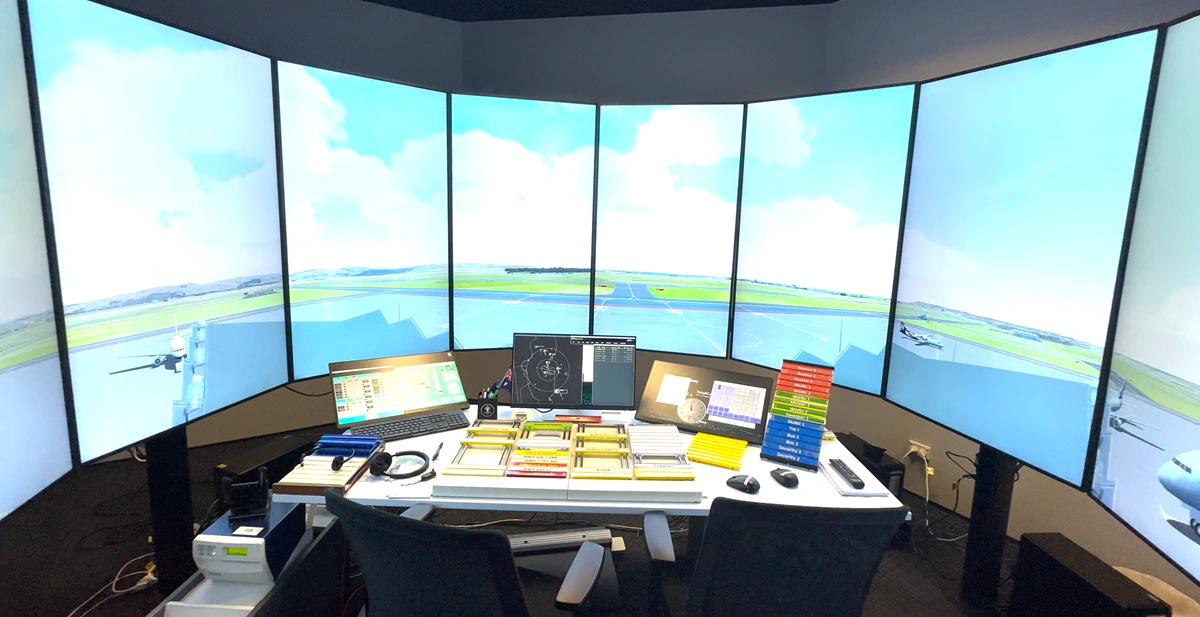
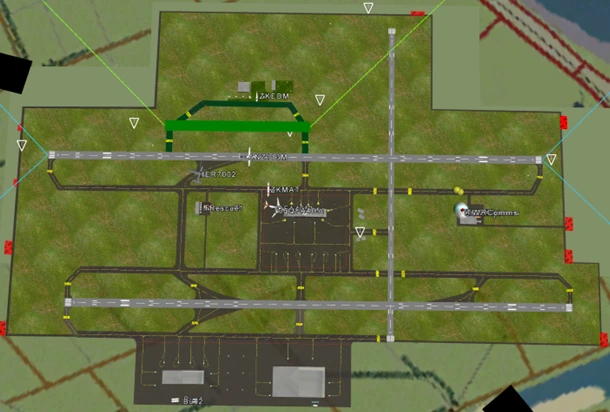
Forest – officially designated NZFZ – is a purpose-built training aerodrome that lives inside our TotalControl simulator environment. It gives us a flexible, controlled space where we can deliver both ab initio and operational refresher training, ranging from simple early-stage exercises through to complex multi-position operations.
Because Forest is generic and not tied to any real-world aerodrome, our instructors can shape it to suit any exercise, any student, and any customer requirement. That flexibility is at the heart of why it works so well.
How Forest came to be
Forest has been part of Airways’ training programme for around 30 years. In the early days, we trained ab initio controllers using the procedures of Napier aerodrome. Napier was a practical choice, but it came with a real constraint: the AIRAC cycle meant procedures were updated every 28 days, making it difficult to keep training objectives stable.
We needed a place to stand still while students moved forward. So we created one.
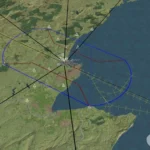
Originally called Footrot, the aerodrome evolved from Napier’s foundations into something entirely its own – a fictional island located about 30 nautical miles off the South Island of New Zealand, sitting within the NZ domestic FIR but free from real-world amendment cycles. Being on an island also meant we didn’t need to worry about surrounding terrain and geography. It was practical thinking that turned out to have lasting benefits.
The physical details of Forest were drawn from the real world New Zealand aviation environment: the tower view is based on Napier, the rescue fire station on Dunedin, the maintenance hangar on Nelson, and the airport terminal building echoes the old Christchurch terminal. It’s a composite of familiar places, frozen in time and able to be enhanced whenever our training requirements call for it.
A training environment built for every scenario
Forest International Aerodrome has two independent parallel sealed runways, a crossing sealed runway and a parallel dependent grass runway, eight apron stands, and IFR facilities including RNP, NDB, VOR, and ILS approaches. For customers who need it, we’re able to simplify to single or multiple runway use.
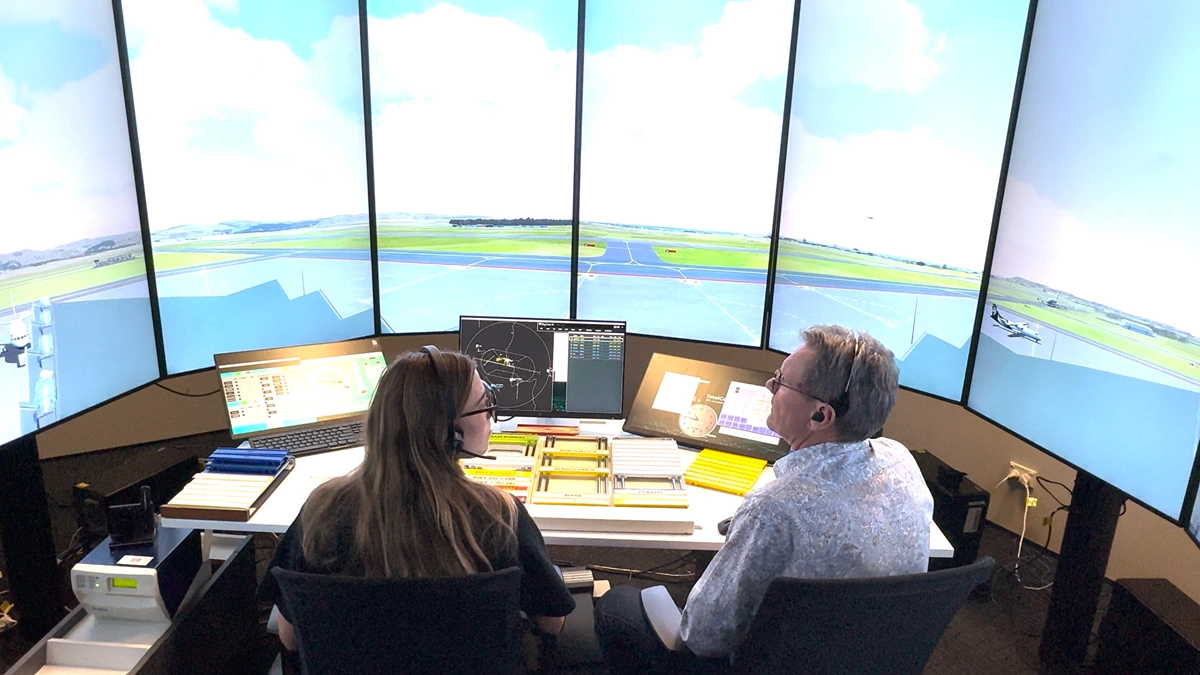
We use Forest to deliver ICAO 052, 053, 054, and 055 courses, for Airways New Zealand and our international trainees. We can use it for single position or multi-position scenarios, and as a training environment it gives us:
- Scalable complexity: Instructors can adjust traffic volume, aircraft types and weather conditions to match where a student is in their learning journey
- Full exercise control: The ability to pause, rewind, and repeat means critical moments can be discussed and practised again
- Consistent, repeatable scenarios: Because Forest doesn’t change unless we decide it should, students across different cohorts train in a genuinely comparable environment
- Professional AIP documentation: All procedures are designed to professional standards by our own Aeropath aeronautical information management (AIM) team, so trainees are working with realistic, properly published charts from day one.
Forest’s reach and legacy
Over the past 15 years or so more than 400 Airways air traffic control students have trained in Forest, and that’s before counting international students from Hong Kong, Saudi Arabia, United Arab Emirates, Vietnam and elsewhere who have come through our training programmes. Some of our global customers also include Forest as part of their own TotalControl package, or commission a customised version tailored to their local training requirements.
I find it greatly rewarding when experienced controllers return for advanced training and react to stepping back into the simulator. There’s a recognition, a familiarity, that tells me Forest did its job when it mattered. Training environments earn that kind of connection only when they feel real enough at the time.
What’s next for Forest
Forest continues to evolve alongside TotalControl. We’ve added parallel runways, complex ground paths, introduced RNP approaches, and kept pace with changing customer requirements over the years. That process of ongoing refinement will continue, with Forest enhanced when our training objectives call for it, not when the AIRAC cycle does.
If you’re an air navigation service provider exploring simulation-based ATC training, or you’d like to know more about how Forest and TotalControl can be configured for your requirements, we’d love to hear from you.
About the author
Kelly de Lambert
Head of ATS Training
Kelly de Lambert leads the Airways International training academy and is responsible for the design and delivery of all air traffic services training programmes, for both Airways New Zealand and global customers. Her work plays an important part in helping ANSPs to attract and build skilled and confident controllers, at a time when training effectiveness and workforce shortages are major global challenges.
In her role as Head of ATS Training for Airways International, Airways New Zealand’s commercial arm, Kelly oversees the air traffic services training pathway for academy trainees, from curriculum design to assessment. She works closely with Airways’ operational and technical teams to bring evidence-based methods into each stage of training, with a strong focus on competency-based training, interactive learning resources and quality assurance.
Prior to joining Airways, Kelly spent close to three decades in tertiary and corporate education in roles that included corporate trainer, lecturer, programme manager and academic quality manager. She holds a Bachelor of Science and a Diploma in Adult Teaching and Learning from the University of Canterbury.